
By Sandra Serrano — Bio Integrative Physio · Dubai · beoptimalhealth.com
Most treatment approaches focus on what the body produces — pain, inflammation, restricted movement, poor performance. Very few ask what is driving the production of those outputs in the first place.
The answer, in a significant number of cases, does not lie in the fascia or the muscle itself. It lies in the body’s receptors (mechanoreceptors and the sensory information they continuously send to the brain.
What Are Mechanoreceptors?
Mechanoreceptors are sensory receptors distributed throughout the body — in muscles, joints, fascia, skin, tendons, ligaments, and visceral tissue. Their primary function is to detect mechanical stimuli — pressure, stretch, vibration, movement — and transmit that information to the central nervous system in real time.
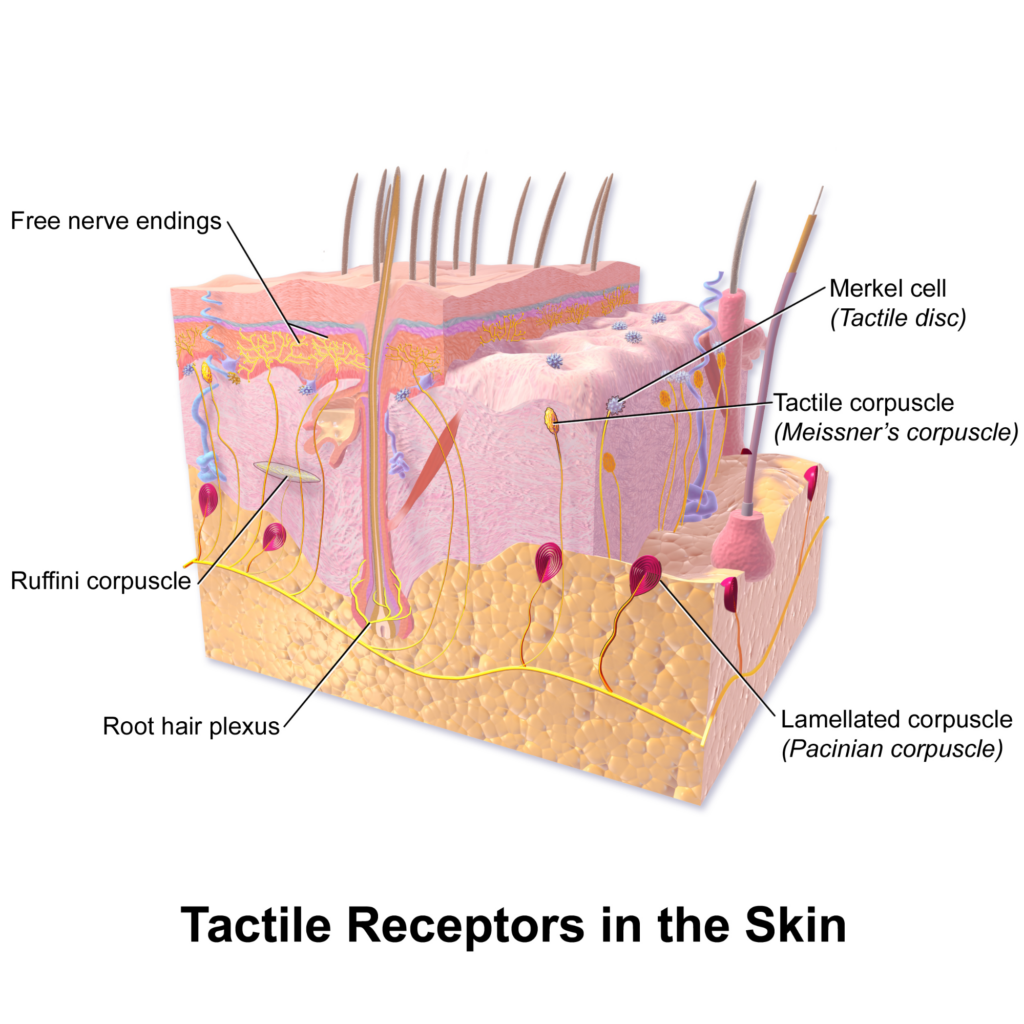
They are the body’s sensory reporting system. Constantly communicating the state of every tissue, every joint, every organ to the brain.
The Main Types of Mechanoreceptors and What They Do
Understanding the different types helps explain why stimulating specific areas produces such significant systemic effects.
Meissner’s Corpuscles — located in the superficial skin, particularly in the fingertips, palms and soles. They detect light touch and low-frequency vibration. Highly responsive to gentle manual contact and skin stimulation.
Pacinian Corpuscles — found in deeper skin layers, fascia, joints and visceral tissue. They respond to deep pressure and high-frequency vibration. Key receptors in fascial and visceral manual techniques.
Ruffini Endings — present in skin, joint capsules and fascia. They detect sustained pressure, skin stretch and joint position. Particularly important in postural regulation and sustained manual holds.
Merkel’s Discs — located in the superficial skin. They respond to sustained pressure and fine spatial detail. Involved in body mapping and interoceptive awareness.
Muscle Spindles — found within muscle fibres. They detect changes in muscle length and rate of stretch. Fundamental to proprioception, postural control and motor coordination. When dysregulated, they contribute directly to chronic muscle tension and movement compensation.
Golgi Tendon Organs — located at the muscle-tendon junction. They detect tension and force in the tendon. Important in regulating muscle activation and preventing overload. Disrupted function contributes to joint instability and recurring injury.
Free Nerve Endings — distributed throughout almost every tissue in the body. They respond to pressure, temperature, chemical stimuli and pain. Include nociceptive receptors — when sensitised, they maintain chronic pain states even without active tissue damage.
Interstitial Receptors (Type III and IV) — found in muscle, fascia and visceral tissue. They respond to mechanical, chemical and metabolic stimuli. Directly linked to autonomic regulation, inflammatory response and vagal tone modulation.
Why Mechanoreceptors Become Disrupted
Mechanoreceptor function can be altered by a wide range of factors — many of which are never assessed in conventional treatment:
Scars and surgical wounds disrupt the sensory map of surrounding tissue. Head impacts and whiplash alter cervical mechanoreceptor input to the vestibular nuclei. Dental procedures and jaw dysfunction reduce orofacial mechanoreceptor signalling through the trigeminal pathway. Chronic stress and emotional load alter the sensitivity of mechanoreceptors throughout the body. Visceral dysfunction reduces input from the gut-brain axis. Sedentary behaviour and reduced movement progressively diminish mechanoreceptor stimulation.
In all of these cases, the result is the same — inaccurate, reduced, or dysregulated input to the brain. And an inaccurate input generates an inaccurate output.
The Relationship Between Mechanoreceptors, Pain and Inflammation
When mechanoreceptor input is reduced or disrupted, the brain fills in the gaps with threat perception. This activates nociceptive pathways — even in the absence of structural damage.
This is the mechanism behind central sensitisation: the nervous system becomes hypersensitive because it is working from incomplete or inaccurate sensory information. The alarm stays on — not because the tissue is damaged, but because the brain cannot confirm that it is safe.
Simultaneously, reduced mechanoreceptor input impairs the body’s ability to regulate inflammation. The vagus nerve — which relies on accurate visceral and peripheral mechanoreceptor input — loses its ability to modulate pro-inflammatory cytokines. The result is sustained low-grade inflammation that persists regardless of dietary changes, supplementation, or physical treatment directed at the symptom site.
Mechanoreceptors and perfomance
In the context of movement and performance, mechanoreceptors are equally critical. They provide the brain with the real-time proprioceptive data it needs to coordinate muscle activation, regulate joint stability, and control movement patterns.
When mechanoreceptor input from a joint or muscle is reduced — due to prior injury, scar tissue, or chronic disuse — the brain compensates by reducing motor output to that area. This manifests as unexplained weakness, reduced range of movement, or movement patterns that persistently recruit compensatory muscles rather than the primary ones.
This is why isolated strength training and mobility work often fail to produce lasting results. The brain will not allow full motor expression to an area it cannot accurately read.
How We Stimulate Mechanoreceptors in the Bio Integrative Physio Method
In the BIP method, mechanoreceptor stimulation is the primary therapeutic target.
We assess which input channels are generating inaccurate or reduced information — visual, vestibular, orofacial, cervical, visceral, soft tissue — and apply specific sensory reflex techniques to restore accurate mechanoreceptor signalling in those pathways.
This includes manual techniques applied to specific receptor-dense areas, reflex integration protocols, movement-based sensory stimulation, and orofacial and visceral input assessment.
The goal is not to treat the symptom. The goal is to restore the quality of the information the brain receives — so that the brain can regulate the body accurately, without the need for protection, compensation, or alarm.
When we change the input — the brain changes the output.
Pain reduces. Inflammation settles. Movement becomes more efficient. Energy returns.
Summary
Mechanoreceptors are the foundation of how the brain regulates the body. When their function is disrupted — for any reason — the consequences are systemic. When their function is restored, the body regulates itself.
If you have been managing pain, inflammation, or performance limitations without assessing the quality of your sensory input — you have been treating the consequence, not the cause.
→ Take the free Bio Integrative assessment at beoptimalhealth.com
Sandra Serrano- an integrative approach to Physio.